Conference Info
Invited Speaker of International Parallel Session at the 2026 FENDT Forum
Time:2026-06-06
Biography of Mohsen Barzegar

Dr. Mohsen Barzegar is an Auxiliary Researcher at Instituto de Telecomunicações (IT), Portugal, working in the Instrumentation and Measurements group. His research is in nondestructive testing (NDT), structural health monitoring (SHM), ultrasonic guided waves, signal processing, damage imaging and AI-assisted diagnostics. He joined IT as a researcher in 2020 and has since contributed to national and international research activities in guided-wave-based inspection and structural integrity assessment.
Nonlinear Guided Wave Mixing Method for Fatigue Micro-Cracks Detectionin In Rails
Huapeng Chen
Rails are subjected to long-term cyclic loading from trains during service, which leads to material property degradation. Slip bands form in the medium and gradually develop into micro-cracks, closed cracks, and eventually macroscopic cracks. These defects compromise the load-bearing capacity of rails and pose serious safety risks. Compared with conventional linear guided wave techniques, nonlinear ultrasonic guided wave technology is capable of detecting early-stage rail damage before macroscopic interfaces appear, while retaining the advantages of guided wave–based methods, such as high sensitivity to defects, fast inspection speed, and large coverage range. In this study, the propagation characteristics of guided waves in steel rails are investigated using the semi-analytical finite element method. The mode shapes of guided wave modes are analyzed. For the wave mixing conditions in rails, guided wave mode pairs at different frequencies are selected to satisfy both the phase matching condition and the non-zero power flow condition. Since ultrasonic guided wave excitation often generates unwanted modes that are ineffective for detection, corresponding phased array is designed to excite the desired guided wave mode pair, and suppressing spurious modes and significantly improving the excitation efficiency of the expected modes.The effects of crack angle and crack area on the mixing-induced second harmonic signals are systematically studied for both micro-cracks and closed cracks in steel rails. A complete methodology is proposed, including the selection of wave mixing mode pairs, phased array excitation, and crack characterisation. This approach markedly enhances the sensitivity and accuracy of fatigue damage detection in rails.Finally, guided wave experiments are conducted to detect internal cracks in steel rails. The experimental results validate the effectiveness of the proposed nonlinear ultrasonic guided wave mixing method for detecting fatigue micro-cracks in rails.
Biography of Huapeng Chen
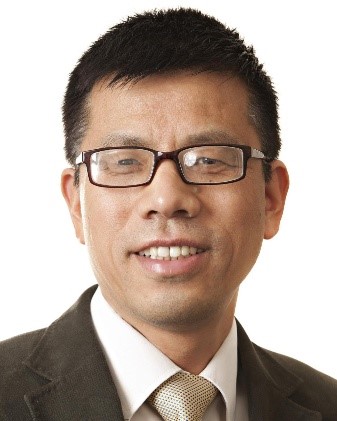
Prof. Chen Huapeng is a doctoral supervisor. He is the Founding Director of the Jiangxi Provincial Engineering Research Center for "Intelligent Transportation Infrastructure", a Leading Innovative Talent under the Jiangxi "Double-Thousand Plan" (Long-Term Project), and the Director of the "Intelligent Transportation Infrastructure" Research Institute at East China Jiaotong University. Formerly, he served as a Full Professor and Chair in the Department of Engineering Science at the University of Greenwich, UK, where he also led two research centers: the Innovation and Intelligent Structures Research Centre and the Engineering Mathematics and Simulation Research Centre. He is a Fellow of the Institution of Civil Engineers (FICE) in the UK, a Fellow of the Higher Education Academy (FHEA), a Chartered Civil Engineer (CEng), and an Academic Mentor for the UK National Structural Integrity Research Centre. Professor Chen was a visiting scholar at Imperial College London and earned his Ph.D. from the University of Glasgow in 1998. He has served as an invited expert reviewer for over ten international and national research funding bodies, an editorial board member for five internationally renowned journals, and a guest editor/editor for more than ten special issues of international academic journals. He also holds the position of Associate Editor for the ASCE Journal of Aerospace Engineering. His long-term research focuses on structural health monitoring, intelligent transportation infrastructure, structural performance assessment, and intelligent operation and maintenance. Professor Chen has independently led more than 20 longitudinal research projects, supported by funding bodies such as the UK Natural Environment Research Council (NERC), the Royal Academy of Engineering Newton Fund (RAEng), the National Key R&D Program of China, and the National Natural Science Foundation General Program. He has supervised over 20 doctoral students and postdoctoral researchers, as well as more than 70 master’s students. He has authored over 300 academic papers and published an English monograph titled "Structural Health Monitoring of Large Civil Engineering Structures" with Wiley. He has been consistently listed in the Stanford University ranking of the world’s top 2% scientists in Civil Engineering and Engineering fields, both for "Career-Long Impact" and "Annual Impact".
Frequency Multiplexed Truncated-Correlation Tomography (FM-TCT)
Hai Zhang